Blog · Family · Buchen · Alsace
My mother's side of the family
From Buchen and Alsace to the Bronx
My father's family comes from Heitersheim, as I wrote in my story about its wine. My mother's family came from two other corners of Germany's old southwest: the Odenwald hills of northern Baden, and Alsace, just across the Rhine. Both families ended up in the Bronx, and that is where this story comes together.
Joseph: A Cabinetmaker from the Odenwald
My grandfather, Joseph Noe, was born on March 2, 1905, in Oberneudorf, a village that is now part of Buchen im Odenwald. His parents were Johann (John) Noe and Anna Geier.
In the summer of 1926, at 21, he boarded the SS Albert Ballin in Hamburg and arrived in New York on July 26. He was a cabinetmaker by trade. Seven months later, in February 1927, he filed his first papers to become an American. In 1933 he was naturalized in federal court in Manhattan, giving his address as Mayflower Avenue in the Bronx. One of the two friends who vouched for him was a pipe organ builder, a fitting friend for a man who worked with wood.
The Carver's Studio
Joseph became much more than a cabinetmaker. By the early 1950s he had his own studio at 1952 Mayflower Avenue, a few doors from where he had lived as a young immigrant, and he carved religious figures and church ornaments, much of it for the Catholic Archdiocese of New York.
On March 25, 1952, the New York photographers Gottscho-Schleisner, best known for their pictures of the city's architecture, came to the studio and photographed his work: the Virgin, St. Francis, Christ as King, an angel kneeling before the Virgin, groups of saints first modeled in clay, a shield with a dove, and panels of carved ornament. Those negatives are now in the Library of Congress, which is how I can show them to you here.
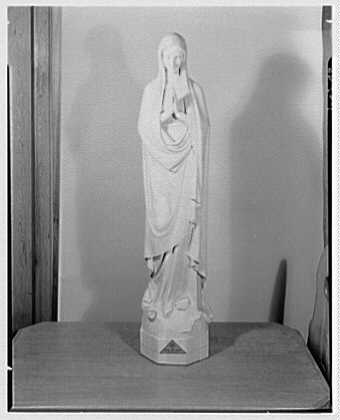
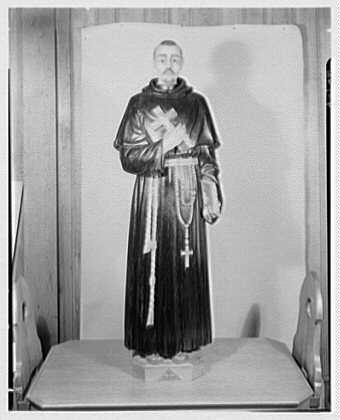
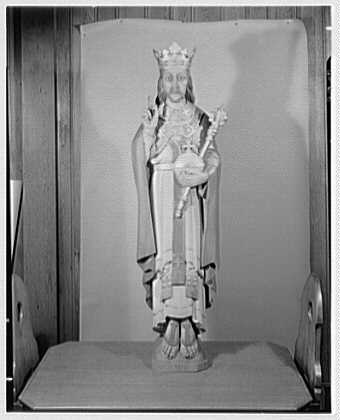
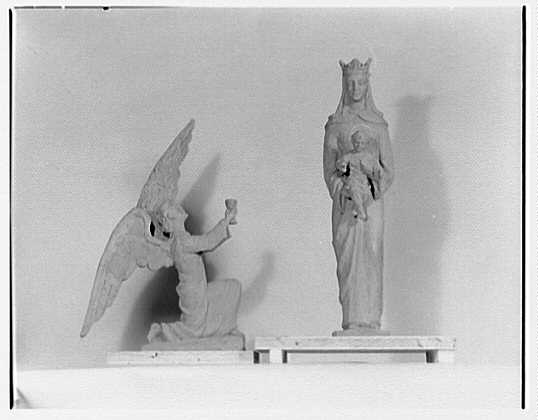
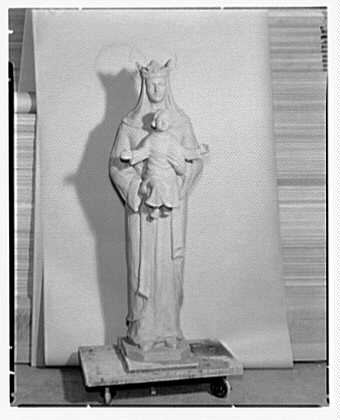
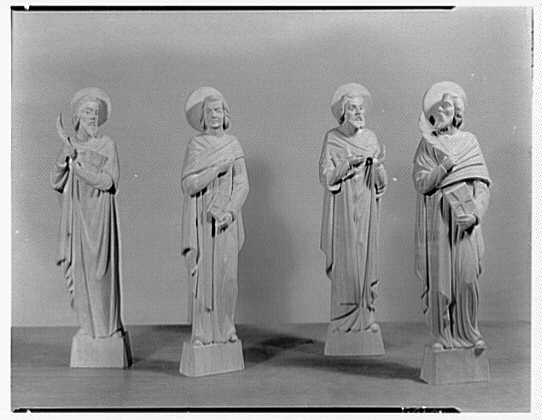
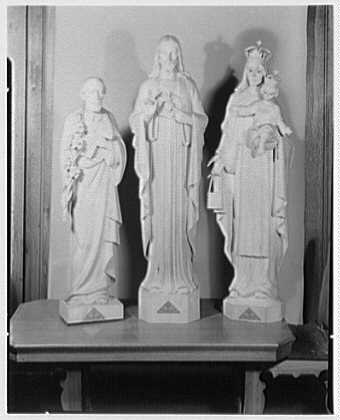
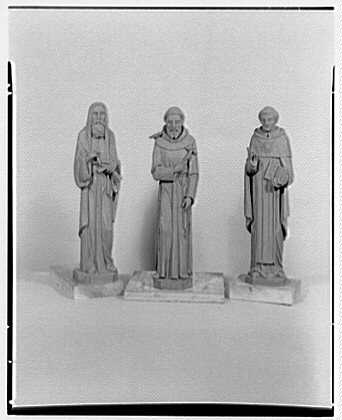
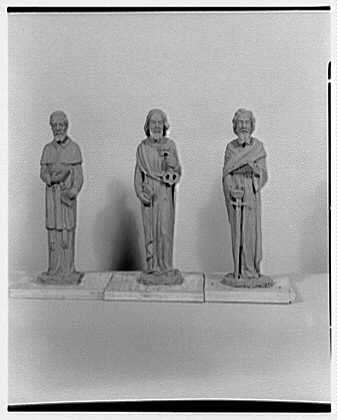
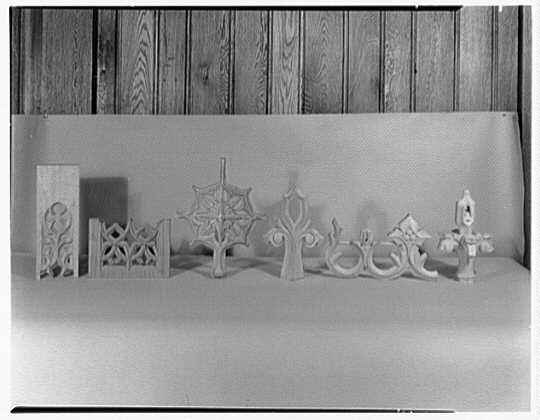
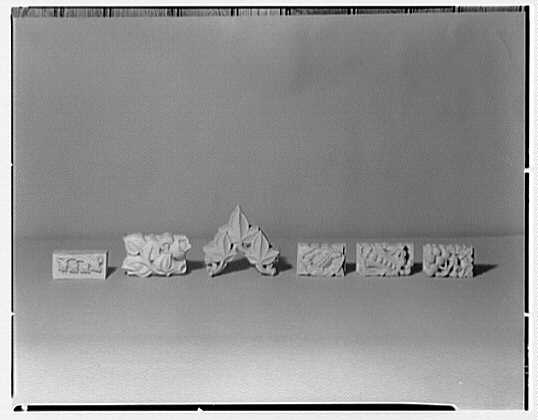
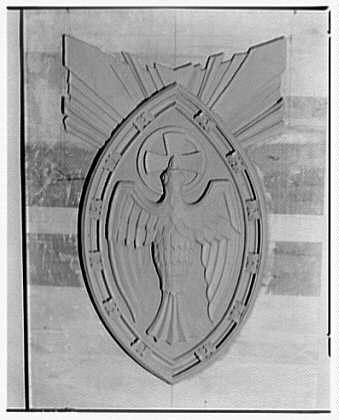
Joseph J. Noe Studio, 1952 Mayflower Ave., Bronx, March 25, 1952. Photos: Gottscho-Schleisner Collection, Library of Congress, Prints and Photographs Division.
He was an inventor, too. In October 1966 he applied for a patent on a church kneeler device: a set of brackets that lets the kneeler in a row of pews be installed quickly, swing up out of the way beneath the seat, and come out easily for repair. U.S. Patent 3,398,988 was granted to Joseph J. Noe of 1952 Mayflower Avenue, Bronx, on August 27, 1968.
Some of his finest work is on Park Avenue. The Church of Our Saviour, at 38th Street, was dedicated by Cardinal Spellman in 1959 and is often called the last great church built in New York City. The ornamental woodwork inside was carved by Joseph Noe Studios. In 1990 Paul W. Reilly, son of the church’s architect Paul C. Reilly, wrote down his memories of the project. He singled out my grandfather’s organ screens as “exceptionally fine pieces of carved millwork.”
When he died, the archdiocesan newspaper, Catholic New York, ran his obituary under the headline “Joseph Noe, 88, Church Artisan.” It names the business he founded, J.J. Noe Church Interiors, and some of the Bronx churches that hold his work: Our Lady of the Assumption, St. Anselm’s, St. Benedict’s and St. Nicholas of Tolentine. It also says he designed the interior of St. Mary’s Cathedral in Ogdensburg, up near the Canadian border. He retired in the early 1970s.
Marie: From Alsace to the Bronx
My grandmother, Marie Antoinette Heberle, was born around 1912 in Alsace. The family believes it was somewhere near Strasbourg. Her father, Antoine Heberle, was born on August 25, 1885, in Lembach, a village in the hills of northern Alsace near Wissembourg.
When Antoine and Marie were born, Alsace belonged to the German Empire. Antoine and his wife, Anna Marie Paulus, settled in the Bronx. In 1942 Antoine was working at the Times Square Hotel on West 43rd Street.
A Bronx Family
Joseph and Marie married in the Bronx on May 18, 1935. By the 1940 census they were living in an apartment near Eastern Boulevard with twin baby girls, Josette and Marieanne. Josette was my mother, Josephine Rita Noe.
The family later lived on Woodhull Avenue in the Bronx and eventually moved up the Hudson to Kingston. They made that move in 1988. My grandfather died at home in Kingston on February 23, 1994, at 88, and is buried in Wiltwyck Cemetery there. My grandmother died in 2000.
Church and the German clubs were at the heart of their community. That is where my mother met my father, Franz Brendle, a young man from Heitersheim who had trained as a Kaufmann, a merchant, before he came over to take on Uncle Erwin's shop.
Two Sides, One Southwest
So both sides of my family come from Germany's southwest. The Brendles come from the Markgräflerland, the Noes from the Odenwald, and the Heberles from Alsace, just across the Rhine from Heitersheim. When I take a group to Strasbourg and Colmar on the Christmas Market Trip, or through the Black Forest on the Summer Wine Trip, I am traveling through the country my grandparents left behind.
Christmas Market Trip · December 2–9, 2027
See Alsace with me
Strasbourg, Colmar and Freiburg at Advent, with a small group of twenty.
See the tripSources
- Gottscho-Schleisner Collection, Library of Congress: "Joseph J. Noe Studio, 1952 Mayflower Ave., Bronx, New York" (12 photographs, March 25, 1952): link
- U.S. Patent 3,398,988, "Church kneeler device," Joseph J. Noe, granted August 27, 1968 (Google Patents): link
- New York City marriage record, Joseph Noe and Marie A. Heberle, Bronx, May 18, 1935 (FamilySearch): link
- Petition for naturalization of Joseph Noe, U.S. District Court, Southern District of New York, 1933 (FamilySearch): link
- 1940 U.S. Census, Noe household, Bronx (FamilySearch): link
- World War II draft registration of Antoine Heberle, Bronx, 1942 (FamilySearch): link
- Obituary, “Joseph Noe, 88, Church Artisan,” Catholic New York, 1994 (copy courtesy of the Archives of the Archdiocese of New York)
- Paul W. Reilly, “The Story of ‘The Last Great Church Job’: The Church of Our Savior, New York, New York,” November 12, 1990, Archives of the Archdiocese of New York
- Family recollections of Franz Brendle